

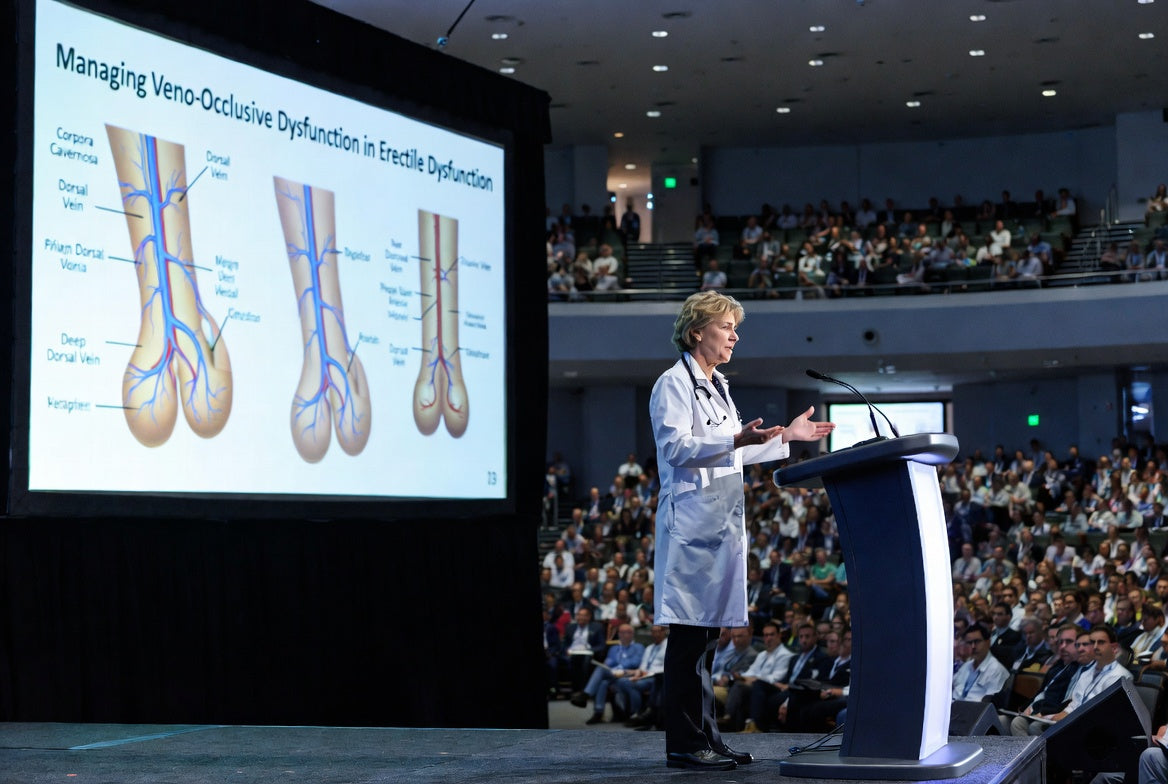
How Xialla Addresses Veno-Occlusive Dysfunction (Venous Leak) in Erectile Dysfunction
Stay up to date.
A clinically informed, biomechanical perspective for patients and the urology community
Venous leak, also known as veno-occlusive dysfunction (VOD) or corporoveno-occlusive dysfunction (CVOD), represents one of the most significant yet often under-addressed contributors to erectile dysfunction (ED). It occurs when blood enters the corpora cavernosa adequately but escapes too rapidly through the venous system, preventing the sustained intracavernosal pressure required for a rigid erection.
Estimates suggest a venous component contributes to a substantial proportion of vasculogenic ED cases — potentially up to 50–75% in various cohorts — particularly among younger men, those with post-prostatectomy changes, diabetes, or age-related vascular alterations.
While phosphodiesterase type 5 inhibitors (PDE5i) remain first-line therapy by enhancing arterial inflow, they frequently prove insufficient when outflow is excessive. This creates a clear clinical need for targeted approaches to restore effective veno-occlusion.
Xialla is a patented, FDA Class II exempt medical device specifically engineered to provide stable, comfortable external venous compression. Its design directly addresses the biomechanical shortcomings of traditional constriction rings while complementing other therapies.
The Physiology of Erection: Balancing Inflow and Outflow
A normal erection requires precise hemodynamic coordination. Sexual arousal triggers nitric oxide-mediated relaxation of cavernosal smooth muscle and arterial dilation, dramatically increasing blood flow into the corpora cavernosa via the cavernosal arteries. As the sinusoids fill and expand, intracavernosal pressure rises.
The tunica albuginea, the fibrous sheath surrounding the corpora, becomes stretched and rigid. This expansion compresses the subtunical venules and emissary veins against the inelastic tunica, markedly reducing venous outflow.
The emissary veins drain the sinusoids and course through the tunica; their compression between the expanding erectile tissue and the tunica albuginea is the cornerstone of the veno-occlusive mechanism. Additional drainage occurs via the deep dorsal vein (DDV), circumflex veins, and para-arterial veins, which converge and ultimately drain into the prostatic plexus.
As long as arterial inflow exceeds venous outflow, pressure builds to levels supporting rigidity. Detumescence follows sympathetic activation, smooth muscle contraction, and restoration of venous drainage.
Detailed anatomical studies confirm the complexity of penile venous drainage, with multiple pathways that must be effectively occluded for sustained tumescence.
Pathophysiology of Veno-Occlusive Dysfunction
VOD arises when the veno-occlusive mechanism fails despite adequate (or even enhanced) arterial inflow. Key mechanisms include:
- Structural changes in the tunica albuginea or trabecular smooth muscle: Reduced compliance or atrophy impairs the ability of expanding sinusoids to compress subtunical venules effectively. Age-related fibrosis, diabetes, or androgen deficiency can contribute.
- Incomplete smooth muscle relaxation: Excessive adrenergic tone or endothelial dysfunction prevents full corporal expansion needed for venous compression.
- Venous shunts or congenital/acquired abnormalities: Direct communications bypassing the compression zone.
- Post-prostatectomy or pelvic surgery effects: Nerve injury, fibrosis, or altered hemodynamics frequently lead to secondary VOD.
Clinically, men with predominant VOD often report good initial tumescence that rapidly diminishes during intercourse. Color Doppler ultrasound with intracavernosal vasoactive injection typically shows normal peak systolic velocity but elevated end-diastolic velocity, indicating poor venous trapping.
Limitations of Current Therapies for Venous Leak
PDE5 inhibitors enhance arterial inflow but cannot fully compensate for excessive outflow. A substantial subset of men achieve only partial or unsustained responses to PDE5i monotherapy when VOD is significant.
Venous ligation or embolization procedures have shown disappointing long-term durability in many cases and are generally considered investigational or not routinely recommended by major guidelines.
Mechanical Venous Occlusion: Rationale and Challenges with Traditional Approaches
Traditional constriction rings apply external pressure to compress the deep dorsal vein and associated structures. However, repetitive thrusting causes ring movement due to low-friction skin sliding over deeper tissues. This can create a “milking” effect that facilitates rather than prevents venous outflow.
Tightening the ring excessively risks ischemia, numbness, or discomfort. Scrotal loops offer limited stabilization because the scrotum itself moves during activity.
The Innovative Design of Xialla: Stabilized Venous Compression
Xialla is constructed from soft, stretchy medical-grade silicone. Its patented anchoring mechanism uses an adhesive pad on the lower back/sacral area, a ring at the base of the penis, and a loop around the scrotum secured with a tab-lock. This draws the device firmly posteriorly, preventing slippage and maintaining consistent compression on proximal venous structures throughout dynamic sexual activity.
Stabilization reduces the need for excessive tightness, improving comfort and preserving arterial inflow. The design supports application whether the penis is flaccid or erect.
Cross-reference: This targeted venous occlusion complements blood retention and reduced venous outflow and increased girth and firmness.
Clinical Evidence Supporting Xialla
In a 2016 trial presented at the World Meeting on Sexual Medicine, 14 of 21 men (66%) experienced significant enhancement in erectile function with the device. A subsequent analysis showed satisfactory salvage in 6 of 11 men (54%) with VOD who had not responded adequately to injection therapy alone.
A 2024 perspective in the International Journal of Impotence Research by Yafi et al. highlights Xialla as a novel option specifically targeting VOD-related ED, noting its versatility as monotherapy or in combination.
Xialla in Combination Therapy and Patient Selection
Xialla synergizes with PDE5i, vacuum erection devices (as a replacement for standard rings), and intracavernosal injections. It is particularly relevant for men with suspected VOD based on history or Doppler findings, partial PDE5i response, or post-prostatectomy ED.
Cross-reference: See also ejaculatory sensation after prostate surgery and stretch-sensitive nerve stimulation for related effects.
Safety Considerations and Proper Use
Use should be limited to 30 minutes or as tolerated. Remove immediately if discomfort, numbness, or discoloration occurs. Consult a physician before use, especially when combining therapies or with conditions such as bleeding disorders or priapism history.
Conclusion
Xialla offers a biomechanically sound, patient-friendly solution for veno-occlusive dysfunction by providing stable external venous compression. Backed by anatomical principles, early clinical observations, and design innovation, it fills an important gap in ED management and supports both standalone and combination approaches.
References
- Yafi FA, Hammad MAM, Elterman D. Xialla®: a novel medical device for addressing erectile dysfunction associated with veno-occlusive dysfunction. Int J Impot Res. 2024. Full text
- Littlemore AM, et al. (Bella AJ). Evaluation of a novel medical device... J Sex Med. 2017 (abstracts).
- Panchatsharam PK, et al. Physiology, Erection. StatPearls. 2023.
- Kaba R, Pearce I. Venous leak and erectile dysfunction. J Clin Urol. 2020.
- AUA Guideline on Erectile Dysfunction (2018 and updates). AUA
- Additional anatomical and review sources in Journal of Sexual Medicine and related publications.
For personalized advice, consult your urologist. Additional resources and support are available at xialla.com.
This article is for general education and is not medical advice. Consult a qualified healthcare provider about your individual situation.


%20or%20corporoveno-occlusive%20dysfunction%20(CVOD),%20repr...)