

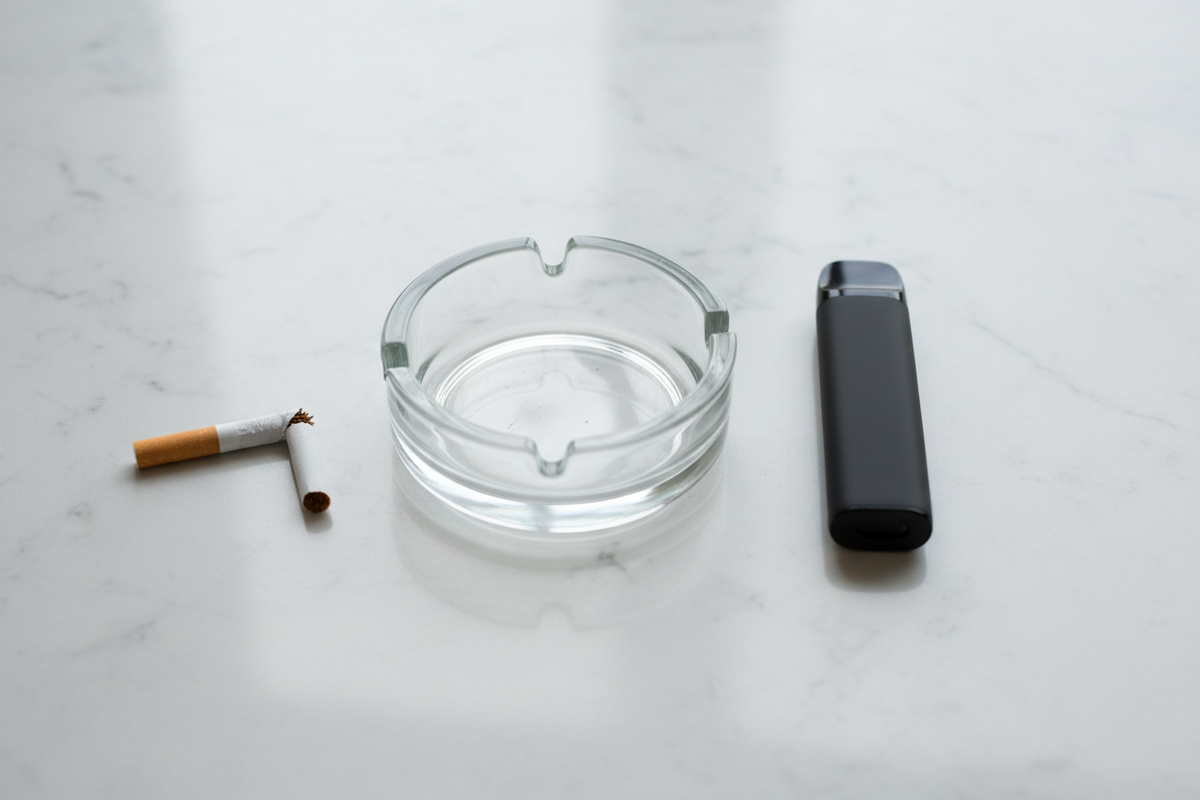
Smoking, Vaping, and Erectile Function: What the Dose-Response Evidence Shows
Stay up to date.
The relationship between smoking and erectile dysfunction is one of the better-quantified findings in this field. For each additional 10 cigarettes smoked per day, the odds of erectile dysfunction rise by 14%. For each additional 10 years of smoking, they rise by 15%. The relationship is dose-dependent in both quantity and duration, which is the pattern that distinguishes a causal effect from an association.
The mechanism is vascular and it acts on both sides of an erection — the arterial inflow and the veno-occlusive retention that holds blood in place. This article covers what the evidence shows, what happens on stopping, and what is currently known about vaping.
What the dose-response evidence shows
Cao and colleagues published a dose-response meta-analysis in The Journal of Sexual Medicine in 2014, pooling observational studies of smoking quantity, smoking duration and erectile dysfunction risk.
For each increment of 10 cigarettes per day, the summary odds ratio for erectile dysfunction was 1.14 (95% confidence interval 1.09 to 1.18). For each increment of 10 years of smoking, the combined odds ratio was 1.15 (95% confidence interval 1.10 to 1.19).
An earlier line of work measured the effect physiologically rather than by questionnaire. In studies of nocturnal penile tumescence — the erections that occur during sleep — an inverse dose-response relationship was observed among male smokers. The heaviest consumers, above 40 cigarettes per day, recorded the fewest minutes of nocturnal tumescence and lost rigidity fastest. That measurement bypasses arousal, partner and psychological context entirely, which makes it a direct read on the machinery.
The mechanism
An erection depends on the endothelium, the single-cell lining of the blood vessels. Endothelial cells produce nitric oxide, the signaling molecule that relaxes the smooth muscle of the penile arteries and the trabecular tissue of the corpora cavernosa. That relaxation permits arterial inflow and allows the erectile tissue to expand.
Tobacco smoke damages this system through several routes. Nicotine produces acute vasoconstriction, narrowing the arteries. Oxidative stress and inflammation reduce nitric oxide availability, so the relaxation signal is weakened. Long-term exposure accelerates atherosclerosis, narrowing the penile arteries structurally. Smoking also promotes fibrotic change in the erectile tissue over time.
The retention consequence follows from the same expansion failure. Blood is held in the penis because expanding erectile tissue compresses the draining veins against the tunica albuginea. Where smooth muscle relaxation and tissue expansion are impaired, that compression is incomplete, and blood escapes as fast as it arrives. This is why smokers frequently describe erections that form and then fade rather than erections that never form, and why oral medication that acts on inflow gives partial results. The mechanism is set out in Venous Leak and Erectile Dysfunction Explained.
The penile arteries are narrower than the coronary arteries, which is why this damage tends to become symptomatic there first. That is the basis of AUA Statement 3, which identifies erectile dysfunction as a marker of cardiovascular risk. Our article on erectile dysfunction and cardiovascular risk covers the association.
What happens after stopping
Some of the effect is acute and reverses quickly. Studies in regular smokers have found that nocturnal penile tumescence and rigidity improve significantly after 24 hours of abstinence, which reflects the removal of nicotine's vasoconstrictive effect rather than any repair of the vessels.
The structural component recovers more slowly and less completely. A systematic review in Sexual Medicine Reviews in 2023 (Verze et al.) examined the evidence on smoking cessation and erectile function and found support for a beneficial effect of cessation on the restoration of erectile function. Recovery is generally better in younger men, in those who smoked for fewer years, and in those without established atherosclerotic disease.
Stopping produces meaningful improvement for many men. A proportion of the damage in long-term heavy smokers is not fully reversible, and continuing guarantees further deterioration. Cessation improves erectile outcomes on its own; the cardiovascular reasons for stopping remain separate and larger.
What is known about vaping
Electronic cigarettes are frequently presented as a harm-reduction option, and the evidence on erectile function specifically is still developing. Several points can be stated with reasonable confidence.
Nicotine is the active vasoconstrictor and is present in most e-cigarette formulations, so the acute effect on penile blood flow is not avoided by switching delivery method. E-cigarette aerosol has been shown to produce endothelial dysfunction in laboratory and short-term human studies, which is the same mechanism that connects combustible tobacco to erectile dysfunction.
Verze et al. (2023) also examined e-cigarettes alongside combustible tobacco in the context of erectile dysfunction. The available data suggests e-cigarette use is not neutral with respect to erectile function. What cannot yet be stated is the long-term magnitude of the effect relative to smoking, because the exposure period in the population is too short for that comparison to have been made properly.
For a man who has switched from cigarettes to vaping and expected his erections to recover, the reasonable expectation is partial improvement rather than resolution — and dual use, meaning both, offers no advantage at all.
What this means practically
If you smoke and have noticed a change in erections, cessation is the single modifiable factor with the clearest dose-response evidence behind it. Nocturnal erectile events can improve within a day of stopping; that early return is measurable rather than theoretical.
Tell your doctor you smoke when erectile dysfunction is being assessed, including if you vape. It changes the interpretation of the findings and it changes which investigations are useful.
If your erections form and then fade, the deficit is on the retention side. External devices designed to limit venous outflow act on that mechanism directly and work independently of vascular recovery, which makes them usable while cessation is underway. Pelvic floor training acts on the same side of the equation. Where a constriction device is used, maximum continuous wear is 30 minutes; remove before sleeping; remove immediately for numbness, coldness, discoloration, or pain — see using a constriction device safely.
Other lifestyle factors act on the same vascular pathway and are covered in our article on lifestyle changes.
Key takeaways
- Each increment of 10 cigarettes per day raises the odds of erectile dysfunction by 14% (odds ratio 1.14); each 10 years of smoking raises them by 15% (odds ratio 1.15).
- Men smoking more than 40 cigarettes per day recorded the fewest minutes of nocturnal penile tumescence and lost rigidity fastest.
- The mechanism is endothelial damage and reduced nitric oxide availability, impairing both arterial inflow and the tissue expansion that compresses the draining veins.
- Nocturnal penile tumescence and rigidity improve significantly within 24 hours of stopping.
- Longer-term recovery is supported by the evidence but is partial in long-term heavy smokers.
- Nicotine in e-cigarettes produces the same acute vasoconstriction, and e-cigarette aerosol has been shown to cause endothelial dysfunction. Long-term comparative data does not yet exist.
References
- Cao S, Gan Y, Dong X, Liu J, Lu Z. Association of quantity and duration of smoking with erectile dysfunction: a dose–response meta-analysis. The Journal of Sexual Medicine. 2014;11(10):2376–2384.
- Kovac JR, Labbate C, Ramasamy R, Tang D, Lipshultz LI. Effects of cigarette smoking on erectile dysfunction. Andrologia. 2015;47(10):1087–1092.
- Verze P, Cai T, Lorenzetti S. Cigarette smoking and erectile dysfunction: an updated review with a focus on pathophysiology, e-cigarettes, and smoking cessation. Sexual Medicine Reviews. 2023;11(1):61–73.
- Burnett AL, Nehra A, Breau RH, et al. Erectile Dysfunction: AUA Guideline. American Urological Association, 2018 (amended 2020). Statement 3.
If you have questions about anything in this article, write to us at hello@xialla.com. We read and answer every message.
This article is for general education and is not medical advice. Consult a qualified healthcare provider about your individual situation.