

Testosterone and Erectile Dysfunction: What Low Testosterone Explains and What It Does Not
Stay up to date.
Men who are told their testosterone is low often expect that correcting it will restore their erections. For most, it does not. Testosterone has a strong and well-documented effect on sexual desire, and a much weaker and less consistent effect on erectile rigidity. Understanding that difference prevents a common and expensive detour.
This article explains what testosterone does, what the guideline says about measuring it, what the treatment trials actually found, and why a man whose desire returns but whose erections do not is usually dealing with a separate vascular problem.
What testosterone does, and what it does not do
Testosterone is the principal male androgen. It maintains libido, supports muscle and bone mass, and contributes to the health of the smooth muscle and endothelium inside the penis. Low testosterone, clinically termed hypogonadism, produces reduced sexual desire, fatigue, loss of muscle mass, and mood changes.
An erection is a hydraulic event. Arterial inflow fills the two corpora cavernosa, the smooth muscle within them relaxes, and the expanding tissue compresses the veins that drain the penis against the surrounding tunica albuginea. That compression is what holds blood in. Testosterone influences the tissue quality that makes this possible, but it is not the trigger and it is not the seal.
A man with low testosterone and healthy penile blood vessels will typically notice that he wants sex less often. A man with normal testosterone and impaired veno-occlusion will typically notice that he wants sex normally but cannot maintain an erection. These are different complaints with different causes, and testosterone treatment addresses only the first.
What the AUA Guideline says about measuring it
The American Urological Association's Erectile Dysfunction Guideline addresses testosterone in two places.
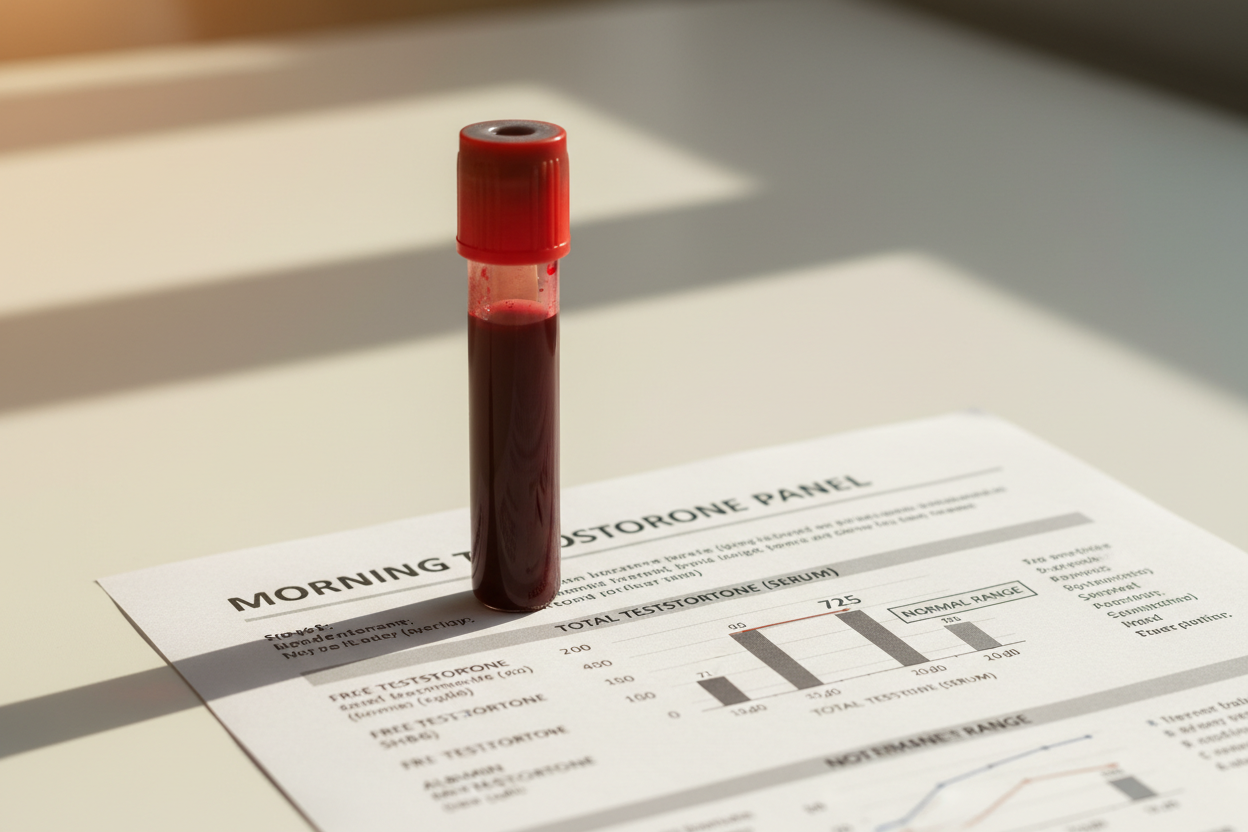
Statement 4 directs clinicians to measure a morning total testosterone level in men presenting with erectile dysfunction (Moderate Recommendation; Evidence Level: Grade C). Timing matters because testosterone follows a daily rhythm and peaks in the morning. A level drawn in the afternoon can read as low in a man whose morning level is normal.
Statement 12 addresses combining treatments: in men with erectile dysfunction and low testosterone, clinicians may offer testosterone therapy in combination with a PDE5 inhibitor (Moderate Recommendation). The construction is deliberate. Testosterone appears in the guideline as an adjunct to an established erectile dysfunction treatment, not as an erectile dysfunction treatment on its own.
Our overview of the guideline, what it is and how urologists use it, explains how these recommendation strengths are assigned.
What the treatment trials found
The largest and most rigorous evidence comes from the Testosterone Trials, reported by Snyder and colleagues in the New England Journal of Medicine in 2016. The study assigned 790 men aged 65 and older, all with serum testosterone below 275 ng/dL and symptoms consistent with androgen deficiency, to one year of testosterone gel or placebo gel.
Testosterone treatment significantly increased sexual activity, sexual desire, and erectile function compared with placebo. The effect on desire was the most consistent of the three. The improvement in erectile function was statistically significant but modest in size, and the trial enrolled men with unequivocally low testosterone — not men with borderline levels.
A broader picture comes from the meta-analysis by Isidori, Corona, Maggi and colleagues, which screened 1,702 articles and included 41 trials: 29 comparing testosterone supplementation against placebo, and 12 evaluating testosterone added to a PDE5 inhibitor. Testosterone supplementation significantly improved erectile function in hypogonadal men. The authors also detected publication bias, and after statistical correction the positive effects retained significance only in trials that were partly or wholly supported by pharmaceutical companies.
Several analyses of combination therapy have found that testosterone added to a PDE5 inhibitor is not clearly superior to the PDE5 inhibitor alone in men with erectile dysfunction and testosterone deficiency. Results across oral, intramuscular and patch preparations have been inconsistent, and a number of trials found testosterone no more effective than placebo for erectile function specifically.
The honest summary is that testosterone treatment reliably improves desire in men who are genuinely deficient, and produces a smaller, less certain improvement in erectile rigidity.
Why desire can return while erections do not
This is the pattern that brings men back to the urologist frustrated after several months of treatment. Testosterone has been normalized, libido has recovered, and erections are unchanged.
The explanation is usually that testosterone deficiency and vascular erectile dysfunction were present at the same time and only one of them was treated. Both become more common with age and both are associated with obesity, type 2 diabetes and metabolic syndrome, so they frequently occur together. Correcting the hormone does not repair the smooth muscle and endothelial function that veno-occlusion depends on.
If erections fill adequately but drain quickly, the problem lies on the retention side rather than the inflow side. That mechanism is described in detail in Venous Leak and Erectile Dysfunction Explained, and the distinction between arterial and veno-occlusive causes is covered in our article on vasculogenic ED. The same retention-side mechanism explains why men with diabetes often get partial results from tablets.
Risks and monitoring
Testosterone therapy is not a benign supplement and requires ongoing supervision. Recognized considerations include suppression of sperm production, which matters for any man who wants to father children; an increase in red blood cell concentration that requires periodic blood counts; and the need for prostate monitoring, since testosterone is not given to men with untreated prostate cancer. Treatment is generally continuous rather than a short course, because levels fall again when it stops.
These are reasons to establish that testosterone is genuinely low, and genuinely the cause of the symptom being treated, before starting.
What this means practically
If you are being evaluated for erectile dysfunction, a morning total testosterone measurement is a standard and appropriate part of the workup. Ask for it if it has not been offered, and ask for the number rather than the word "normal" — reference ranges vary between laboratories.
If your testosterone is low and your main complaint is reduced desire, treatment is likely to help with that complaint. If your main complaint is that erections do not last, expect the testosterone question to be one part of the assessment rather than the answer to it, and expect the vascular side to need separate attention.
Men whose erections fill but do not hold are describing a retention problem. External devices designed to limit venous outflow act directly on that mechanism and are independent of hormone status. Pelvic floor training also acts on the outflow side and costs nothing to try. Where any device is used, observe the wear-time limits and warning signs set out in our guide to using a constriction device safely.
If raising the subject with your doctor is the obstacle, this article on how to have that conversation may help.
Key takeaways
- Testosterone governs sexual desire more reliably than it governs erectile rigidity.
- The AUA Guideline recommends measuring morning total testosterone in men with erectile dysfunction (Statement 4), and positions testosterone as an adjunct to a PDE5 inhibitor rather than a standalone erectile dysfunction treatment (Statement 12).
- In the Testosterone Trials, 790 men with testosterone below 275 ng/dL showed significant improvement in sexual activity, desire and erectile function over one year, with desire the most consistent effect.
- Meta-analysis of 41 trials found benefit for erectile function in hypogonadal men, but detected publication bias; corrected results retained significance mainly in industry-supported trials.
- Testosterone added to a PDE5 inhibitor has not been shown to be clearly superior to the PDE5 inhibitor alone.
- Recovered desire with unchanged erections usually indicates a co-existing vascular problem on the retention side.
- Testosterone therapy requires monitoring of blood counts, prostate health, and fertility considerations.
References
- Snyder PJ, Bhasin S, Cunningham GR, et al. Effects of Testosterone Treatment in Older Men. New England Journal of Medicine. 2016;374(7):611–624.
- Isidori AM, Buvat J, Corona G, et al. A critical analysis of the role of testosterone in erectile function: from pathophysiology to treatment — a systematic review. European Urology. 2014;65(1):99–112.
- Corona G, Isidori AM, Buvat J, et al. Testosterone supplementation and sexual function: a meta-analysis study. The Journal of Sexual Medicine. 2014;11(6):1577–1592.
- Burnett AL, Nehra A, Breau RH, et al. Erectile Dysfunction: AUA Guideline. American Urological Association, 2018 (amended 2020). Statements 4 and 12.
If you have questions about anything in this article, write to us at hello@xialla.com. We read and answer every message.
This article is for general education and is not medical advice. Consult a qualified healthcare provider about your individual situation.